Frequently Asked Questions (FAQs)
Find answers fast. Start with the topic you need:
Disclaimer: The information provided in this Frequently Asked Questions (FAQ) section reflects the opinions and general guidance of The Circumcision Clinic. It is intended for informational purposes only and should not be considered as a substitute for professional medical advice, diagnosis, or treatment. We strongly recommend consultation with one of our healthcare professionals to address your specific concerns and receive personalized care. Every individual's medical needs are unique, and only a thorough evaluation can provide the most accurate and tailored recommendations.
How The Circumcision Clinic is structured
- The Circumcision Clinic™ (The Clinic) coordinates high volume circumcision clinics at several locations across Ontario.
- We bring expert, high volume, circumcision doctors to areas where there is underserved or unmet demand. The more demand, the more frequently we run our clinics.
- We lease or rent space within clean, well-run medical clinics in these local geographies, where we set up our own doctors, administrative, nursing and support staff for the day.
- As an example, 'The Circumcision Clinic' rents space within 'BloorKids Pediatric Clinic' (a wonderful, clean, bright and well-run general and specialist pediatric clinic!). When you set off for your appointment you can look for 'BloorKids' on your GPS. When you enter, you will see a sign and kiosk with 'The Circumcision Clinic' where 'The Circumcision Clinic' admin will check you in and guide you on the start of your journey. You will not interface with any personnel from 'BloorKids' despite this being the host for the appointment. (Though you are welcome and invited to speak to the 'BloorKids' reception about finding a pediatrician or specialist for your child while you are there.)
- If you require any post-procedure follow-up, our team can help you to book your appointment virtually, or at any of our locations based on urgency and availability. (i.e., just because you visited the 'BloorKids' location for the original appointment, doesn't mean you need to return to that location for follow-up care necessarily – though you can if you choose.)
- The Clinic is founded on the idea that doctors and teams that do a high volume of procedures have better outcomes than practitioners that practice circumcision care on an ad hoc or infrequent basis.
- The doctors and nurses work on a shared care model, so when you sign up for an appointment with The Circumcision Clinic™ you agree to the care of any of our wonderful doctors and nurses.
- The Circumcision Clinic leadership will only support doctors who have a proven track record of excellent surgical outcomes AND excellent bedside manner and family-focused approach.
- The Clinic doctors and nurses have standardized and established protocols for all the aspects of care where we have been able, ensuring a consistent experience across practitioners and locations.
-
Elements of care that are standardized amongst all doctors and
locations were developed by consensus and approved by all physicians
providing care. These include:
- Consent forms and information for patients
- Choice of, and route of, local anesthetic nerve block
- Aftercare instructions
-
The doctor providing the circumcision takes on the full responsibility
for the care they provide, so there might be differences between
doctors with regard to inclusion criteria (safe age they will provide
circumcision), technical approach to the procedure (tools, equipment
and time to complete the surgery), or inclusion / exclusion of
patients with minor anatomical variations (minor webbing or rotation
etc.)
- Note: if there is an anatomical variation that makes a clinic-based circumcision unsafe, The Circumcision Clinic™ will coordinate a referral with a specialist that can help you manage in a safer manner.
- If you arrive for a circumcision appointment and after discussion with the team either you or your doctor decide it's not best to move ahead with the procedure, there will be no charge for the visit. We do not want there to be any financial pressure on families to move ahead with the procedure.
What to Expect During Your Visit
- You should expect to be in the clinic for 1-1.5 hours.
-
The time spent in the clinic is typically broken down as follows:
- Informed consent discussion (5-10 min)
- Nerve block injection (5 min)
- Time for the nerve block injection to be fully effective / time to feed the baby (10-20 min)
- Circumcision procedure (10-15 min)
- Teaching how to complete diaper changes and aftercare following the procedure (5 min)
- Discharge home from clinic
What is circumcision?
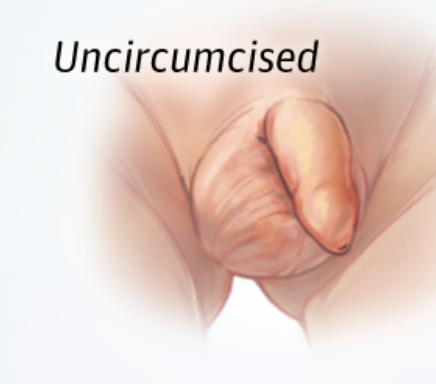
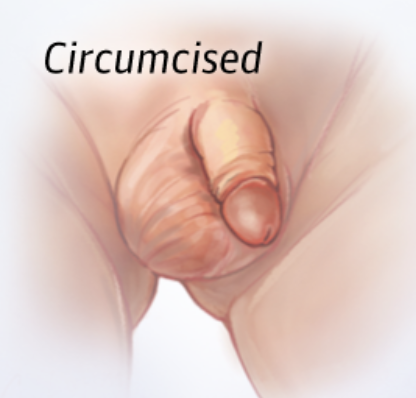
Circumcision is a procedure in which the foreskin (fold of skin that covers the end of the penis) is surgically removed.
Why do people choose to have their child circumcised?
Circumcision is a personal choice. Families most often choose it for cultural, traditional, or religious reasons, or for health considerations such as easier hygiene and a modestly lower risk of urinary tract infections and certain other conditions.
- A decision to circumcise or not to circumcise a newborn is a personal choice.
- Most newborn circumcisions are done for prevention of urinary tract infections, sexually transmitted diseases, and skin problems unique to the foreskin
- As well as traditional, cultural, or religious reasons.
Custom / Culture / Religion
Circumcision of the male infant is commonly done by custom. Many parents feel it is important that their son looks like his father or peers or have a religious obligation to have their son circumcised.
Cleanliness
Circumcision makes cleaning the penis easier. A normal secretion, which is cream-coloured and somewhat waxy, is formed under the intact foreskin. Circumcision prevents this buildup, but the buildup can also be prevented by proper hygiene during bathing. Circumcision does not eliminate the need for proper hygiene, though it makes it easier.
Prevention of cancer of the penis
Penile cancer is an extremely rare condition of adult life. It is less common in circumcised men.
Decreased incidence of infection
Circumcision will slightly reduce the risk of urinary tract infections in males, both as infants and in adulthood. The incidence of such infections in the first year of life is reduced from 1 in 100 to 1 in 1,000. Circumcision has also been shown to be associated with a lower risk for some sexually transmitted infections, including HIV, particularly in areas where the use of safe sexual practices is low.
Prevention of paraphimosis
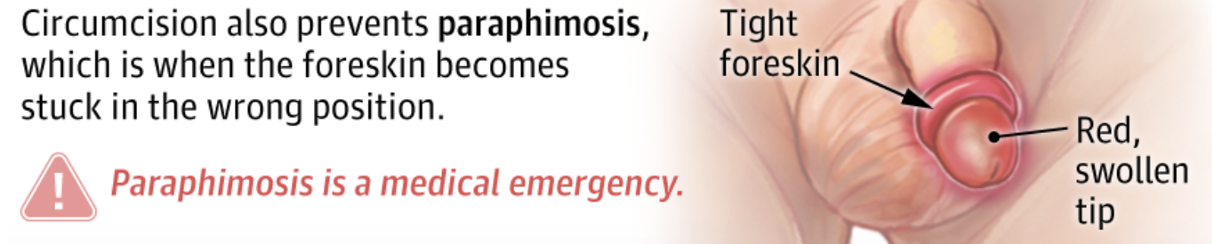
If a still-tight foreskin gets retracted behind the head - and is left retracted, it can act as a tourniquet, decreasing blood supply to the tip of the penis. This strangles the blood flow to the head and represents a medical emergency. This may need to be surgically corrected. Circumcision prevents this uncommon complication from occurring.
Reasons to choose NOT to have a circumcision
Equally valid reasons to choose NOT to circumcise include the discomfort involved, the small but real surgical risk (complications occur about once every 500 procedures), and the cost. Routine newborn circumcision is not covered by OHIP.
Pain
Although the maximum pain-relieving actions will be taken for your baby's comfort on the day of the procedure, there will be some degree of discomfort during the visit and through the first few days of recovery.
Surgical risk
The vast majority of circumcisions are performed without any complications. However, no surgical procedure (and circumcision is a surgical procedure) can be totally risk-free. Complications include: bleeding, infection, adhesion formation, cosmetic deformity, trauma to the penis, excessive removal of the foreskin, and functional defects. These occur once every 500 circumcisions.
Expense
Routine newborn circumcision is not covered by OHIP and therefore there is a cost attached to the procedure. Although parents have the option of delaying circumcision until a time beyond the newborn period, these delayed circumcisions represent a more involved surgical procedure, usually performed with general or regional anesthesia. It is important to note that 1 in 100 uncircumcised adults may require a circumcision for medical reasons.
Surgical risk in detail:
Most circumcisions heal without any complications. When problems occur they are usually minor and short-term; serious complications are very uncommon.
Minor short-term problems:
- Slight oozing or slight bleeding (normal and expected)
- Bruising and swelling
- Superficial infection of the circumcision site or at the tip of the penis
- Irritation of the exposed tip of the penis (glans)
Minor long-term problems:
- The urethra, which leads from the bladder to the tip of the penis, can be damaged at its point of exit
- The newly exposed meatus (urethral opening) can become stenotic (small) due to chronic irritation now that it is exposed to the diaper
- Inappropriate scarring
- Unintended removal of excessive skin layer (or layers) of the penis
- Unintended removal of too little skin, leaving some redundant foreskin behind
- Asymmetry to the cut line
- The site of foreskin removal can scar, leaving an opening too small for the skin to retract over the penis (post circumcision phimosis)
Major problems that are very uncommon:
- Complete removal of the skin covering the shaft of the penis
- Significant, life-threatening bleeding, requiring stitches or other measures to stop the bleeding. Fluid administration or blood transfusion are needed in cases of severe blood loss
- Serious, life-threatening bacterial infection
- Partial or full removal (amputation) of the tip of the penis
Do parents ever arrive at the clinic, and then decide not to move forward with a circumcision procedure? Why does this happen? What do I need to know about this scenario?
Yes, and if you or your doctor decide on the day not to move ahead, there is no charge for the visit.
If you arrive for a circumcision appointment and after discussion with the team either you or your doctor decide it's not best to move ahead with the procedure, there will be no charge for the visit.
- We do not want there to be any financial pressure on families to move ahead with the procedure.
Some common scenarios not to move forward with a circumcision even after arriving in the clinic:
- Some families arrive thinking that it is medically necessary for them to circumcise their child, and we dispel that idea.
- After learning more about the risks or the healing process, some families will change their mind.
- Sometimes parents just need a bit more time, especially if there is one partner who is not sure about the choice of circumcision.
- We encounter an anatomical contraindication to a clinic-based circumcision.
To expand on the points above:
- Some families arrive thinking that it is medically necessary for them to circumcise their child, and we dispel that idea.
- Elective newborn circumcision is a choice based on the personal assessment of risks and benefits after thoughtful deliberation by the parents.
- Our team will never convince a parent that a circumcision is a better choice than not circumcising.
- The major pediatric and urologic societies tend to describe routine circumcision as not necessarily having a clear benefit.
- A circumcision cannot be reversed.
- If your child develops a medical indication for circumcision later in life the cost of the procedure is covered by the Ontario Health Insurance Plan (OHIP).
- After learning more about the risks or the healing process, families will change their mind.
- A major complication, though rare, can be devastating for the child or the family – and parents need to go into the procedure knowing that, though extremely rare, there can be bad outcomes (even with clinics and doctors that have great reputations).
- Sometimes parents need a bit more time, especially if there is one partner who is not sure about the choice of circumcision.
- We will never try convincing you that a child needs to be circumcised, but we are happy to explain all the ways that we mitigate pain and risk. One way we help is by offering quick access to follow-up (we remain available for any questions at any age after the procedure).
- Note: for families that know they want to have their child circumcised, we strongly believe that a newborn circumcision is the best approach and timeframe.
We have found that the baby / family experience is best if children are less than 2 months old at the time of the procedure.
Can parents or family be with their baby during the procedure?
YES!
The clinic is designed to minimize the time your baby is out of your care. Parents and anyone that the parents have brought with them to the clinic are welcome to be with their child for all aspects of the care they receive.
Do parents have to be in the room when the child undergoes the procedure?
NO!
We have staffing to help care for your child, so for parents that are uncomfortable watching the procedure, they do not need to be in the room. We do not rely on parents to hold or restrain their children.