Anatomical & Medical Conditions
Most anatomical variations still allow a safe clinic circumcision, but a few require a pediatric urologist instead. This page covers the conditions we assess (hypospadias, webbed penis, concealed penis) and the health considerations we screen for (Vitamin K status, jaundice), and explains which situations we can treat in clinic and which we refer.
Medically reviewed by Dr. Levin · Last reviewed: July 27 2026When a urologist is needed
What are some anatomical contraindications (issues with the way the penis has developed that prevent the doctors from offering a procedure) to a clinic-based circumcision?
There are several anatomical variations where it is unsafe or ill-advised to move forward with a circumcision without a pediatric urologist consultation. These include:
- Severe hypospadias (meatus outside of the glans, 'pee hole not on the head')
- Severe rotation
- Severe webbing
- Chordee
- Bilateral undescended testicles in the absence of a karyotype
- Very small or very large penis
- Buried penis
We have some more details about these anatomical variations below.
Hypospadias
What is hypospadias and can I still have my son circumcised if they have a hypospadias?
It depends on severity. If the urethral opening (pee hole) is clearly on the head of the penis, we can usually offer clinic circumcision. If it exits at or below the margin of the head, a pediatric urologist is needed.
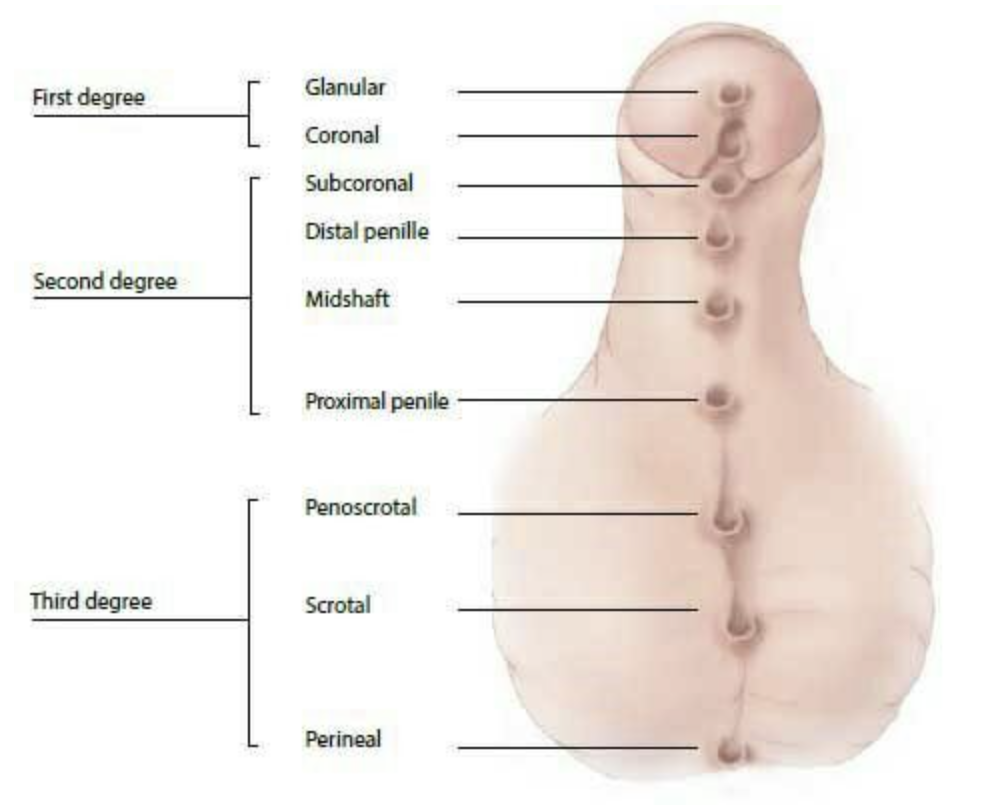
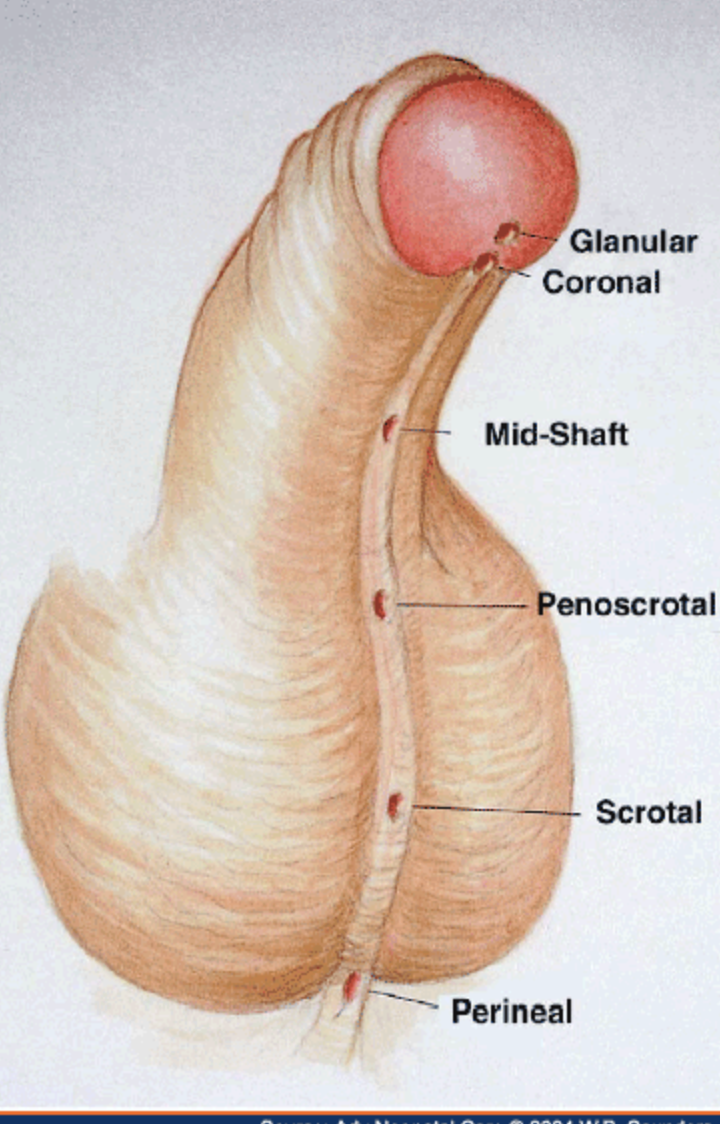
Hypospadias is a congenital condition in which the opening of the urethra, called a meatus (pee hole), is on the underside of the penis rather than at the very tip. The condition is classified by the location of the meatus:
- Distal (anterior): The opening is located near the head of the penis. This is the most common and mildest form.
- Midshaft: The opening is located along the middle of the penis shaft.
- Proximal (posterior): The opening is at the base of the penis, in the scrotum, or behind the scrotum. This is the most severe and least common form.
Hypospadias is present at birth; it occurs in approximately 1 in 200 male infants.
If the pee hole exits on the margin of the head and the shaft skin, or below, we cannot perform a circumcision in our clinic and children need to be seen by a pediatric urologist for a corrective procedure (which can include a circumcision at that time).
For milder forms of hypospadias, where the meatus clearly exits on the glans, we can offer a circumcision in our clinic. The mildest form of hypospadias is a hooded foreskin, where the foreskin is incomplete on the underside, but the meatus (pee hole) is in the correct position at the tip of the glans (head). The circumcision in the clinic will not change the location of the pee hole, and as boys grow they will have to adjust how they aim to compensate. Some families are happy to move forward with a circumcision knowing this. Some families prefer to see a pediatric urologist for a more comprehensive discussion about what is required to move the pee hole if necessary.
For families of boys with mild hypospadias (pee hole exits within the head) or a hooded foreskin who know they do not want to see a pediatric urologist, or have already seen a pediatric urologist who has counselled families that a more complicated repair is unnecessary, we are able to offer circumcision in the clinic.
Webbed penis (penoscrotal webbing)
What is a webbed penis or penoscrotal webbing, and can I still have my son circumcised if they have this?
Usually yes, for mild or moderate webbing, we adjust the angle of the cut to preserve skin on the underside. Severe webbing is best treated by a pediatric urologist.
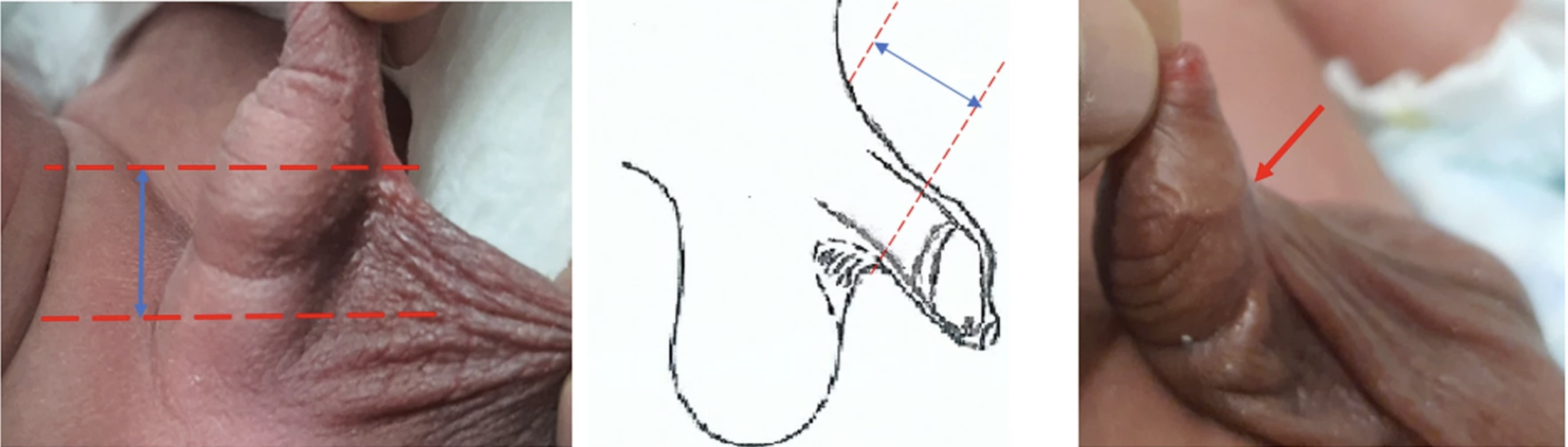
A webbed penis, also known as penoscrotal webbing, is a condition where the skin of the scrotum extends abnormally high onto the underside (ventral shaft) of the penis. This creates a fold or "web" of skin between the penis and the scrotum, which some people describe as a "turkey neck" appearance.
The severity of penoscrotal webbing exists on a spectrum from mild to severe based on how far the scrotal skin extends up the ventral (underside) penile shaft. The more extensive the webbing, the more severe the condition.
For milder forms of webbing, where there is some ventral skin (skin on the underside) still preserved, we can offer a circumcision in our clinic. We make some minor adjustments to the angle of the cut, to preserve the skin on the underside of the penis. This surgical modification is something that neither the parents nor the patient will notice, as the result is simply a normal-appearing penis, as though there was no webbing to begin with. The doctors at The Circumcision Clinic have extensive experience with this form of minor anatomical variation.
In more severe cases, it is preferential for a pediatric urologist to perform the circumcision, as more advanced surgical techniques are required. As mentioned, penoscrotal webbing exists on a continuum, and the choice to move forward in the office with The Circumcision Clinic versus with a pediatric urologist is something that should be decided with a full understanding of the risks and benefits. If the doctor at The Circumcision Clinic does not feel confident that they can provide a good outcome based on the anatomy, they will help coordinate a referral to a pediatric urologist for ongoing management.
Some parents ask, 'wouldn't it be better to have all variations of a webbed penis treated by a specialist in an operating room?'. Firstly, there is good medical evidence to suggest that for appropriately selected anatomy (1,2), the outcomes with an office-based procedure are just as good as a more extensive surgery in an operating room. Since the procedure is less extensive, recovery is quicker, offering an advantage. Furthermore, there are practical considerations that we believe make the clinic setting preferential.
Firstly, an operating room-based procedure often requires a general anesthetic, which poses its own set of risks. Secondly, most pediatric urologists won't offer the procedure until children are older to mitigate both the anesthetic risk, and to give time for the anatomy to grow. Thirdly, in Ontario there are waitlists and backlogs for elective circumcision, so the wait for an operating room-based procedure can extend for several years. Finally, once you require an operating room setting for the procedure, the cost increases, often exceeding thousands of dollars.
For families of boys with mild or moderate webbing, where there is some ventral skin (skin on the underside) still preserved, who know they do not want to see a pediatric urologist, or have already seen a pediatric urologist who has counselled families that a more complicated repair is unnecessary, we are able to offer circumcision in the clinic.
Bawazir OA, Alhallaq OA, Albayhani B, et al. Is the simple webbed penis a contraindication to circumcision? Afr J Urol. 2021;27:132. doi:10.1186/s12301-021-00235-w
Maizels M, Meade P, Rosoklija I, Mitchell M, Liu D. Outcome of circumcision for newborns with penoscrotal web: oblique skin incision followed by penis shaft skin physical therapy shows success. J Pediatr Urol. 2019 Aug;15(4):404.e1–404.e8. doi:10.1016/j.jpurol.2019.05.021. PMID: 31337533.
Concealed or inconspicuous penis
Understanding the 'Concealed' or 'Inconspicuous' Penis and How It Impacts Newborn Circumcision
A chubby fat pad can push shaft skin forward over the healing wound, raising the risk of adhesions and skin bridges. These are common, cosmetic, never an emergency, and manageable, the sections below explain prevention and treatment.
How anatomy affects healing
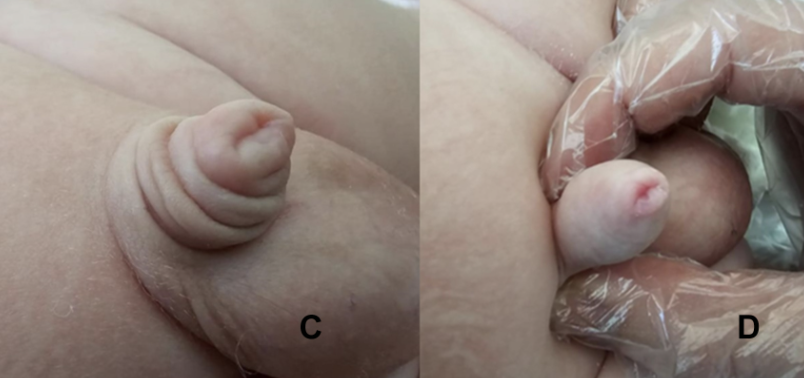
For children with a slightly shorter shaft length and a chubby fat pad at the base of the penis, the anatomy can impact the healing process. Even after the entire foreskin is successfully removed, the fat pushes the shaft skin forward so that the fresh circumferential wound sits on, or in front of, the penis head (glans).
When the fresh wound is in constant contact with the head, the scab has a tendency to stick to the head. If it heals in this position, it can lead to inappropriate attachments called adhesions or skin bridges, or cause the wound to close over in front of the head (called a post-circumcision phimosis).
While we can sometimes anticipate these complications based on a baby's anatomy before circumcision, rapid weight gain in the weeks following the procedure can also cause this to happen to babies with more typical anatomy. Because of this, it is a complication that can happen after any circumcision.
Reassurance for parents
An important thing for parents to understand is that this situation—and these complications—are relatively common.
- Skin bridges and adhesions are a cosmetic complication.
- They do not cause pain, urinary, or sexual dysfunction.
- Treating them is never an emergency, and parents should not be alarmed or overly concerned.
The management of these complications is aimed at making sure the penis looks normal in the long run. Our clinic helps parents navigate this situation consistently, and we can always do what is needed to get a good result.
Our clinic's approach vs. subspecialist referrals
Some clinics and physicians are reluctant to offer circumcision to patients whose anatomy makes these complications more likely, preferring to refer them to a pediatric urologist for surgery in an operating room. This is often because providers want to avoid anticipated complications, or they lack the experience, time, and capacity for the extra follow-up required. Because we have extensive experience counseling parents and managing this specific concern, we are happy to take this on. There is a nuance to positioning the cut—balancing the preservation of the appropriate amount of shaft skin with the need to remove enough to minimize risk—that is learned from high-volume experience.
Your options moving forward
For children at a higher risk of these complications, our team will thoroughly educate parents about the concepts covered in this document. After a full explanation, you will have the chance to decide to:
- Proceed with a circumcision in our clinic.
- Postpone the procedure to give yourselves more time to think.
- Request a referral to a pediatric urologist to discuss operating room options.
- Decide not to move ahead with the circumcision at all.
All of these are reasonable options. We have a policy not to charge families unless we perform the circumcision, ensuring there is no financial pressure. Furthermore, there is no extra out-of-pocket charge for any follow-up care required to address these complications.
Note: There are rare variations of anatomy, such as a true concealed or buried penis, where clinic circumcision cannot be offered safely. In these cases, we will explain the situation and refer you to a pediatric urology specialist.
Aftercare: Preventing and Managing Complications
Routine retractions
Skin bridges, adhesions, and post-circumcision phimosis can sometimes be prevented by gently retracting the shaft skin back to reveal the entire head at each diaper change. This consistently disrupts the scab, preventing it from sticking and healing permanently in place.
⚠️ Important note on retractions: We only recommend routine retractions for children identified at the time of circumcision as higher risk. For children with typical anatomy, routine retractions are unnecessary, and handling the wound will result in more harm than benefit.
The 72-hour rule for high-risk patients
There is a delicate balancing act: start retractions early enough so the scab doesn't heal in the wrong place, but not so early that you pull open the fresh circumcision wound (which can lead to bleeding, delayed healing, and scarring). To balance these risks, we suggest starting retractions exactly 72 hours (3 days) after the procedure. The goal is to slide the shaft skin back just enough to expose the entire head.
What if I feel resistance?
If at any point there is resistance to the skin sliding back, do not force anything. Instead:
- Use the secure patient portal to send us photos of the healing wound.
- Include a brief explanation of what you are experiencing.
- We will correspond with you to determine the next steps (which may include a coaching call, an in-person assessment, or a minor in-clinic procedure to safely release the scab).
In-clinic treatments for developed complications
Adhesions & skin bridges: Once fully developed, they must be mechanically separated. We do this in the clinic using topical or injected local anesthetics to minimize pain. Adhesions usually separate gently without cutting, while skin bridges require a slightly more involved clipping procedure. The cosmetic outcome is excellent with no long-term consequences.
Post-circumcision phimosis (cicatrix): This is when a thick scar contracts and begins to close over the front of the head. Unless it stops the free flow of urine, it is not an emergency. It is initially treated with low-dose steroid creams to soften the scar. In rare cases, the scar needs to be gently dilated open in the clinic under local anesthesia, yielding excellent long-term results.
Health considerations
Does the baby need to have received a Vitamin K injection to have a circumcision?
Babies who received the standard Vitamin K injection at birth can be circumcised at any age we serve. If Vitamin K was declined or given by mouth, we only offer circumcision after 2 months of age due to bleeding risk.
- Vitamin K is crucial for blood clotting because it's a cofactor for enzymes that produce clotting factors, proteins essential for forming blood clots.
- Without enough Vitamin K, the body can't make these proteins, leading to impaired blood clotting and potential bleeding problems.
- Babies are born with low Vitamin K levels because it doesn't readily pass from mother to fetus during pregnancy.
- In Canada, all newborns routinely receive a Vitamin K injection shortly after birth to prevent Vitamin K Deficiency Bleeding (VKDB).
VKDB is a rare but serious condition where a baby's blood cannot clot properly, potentially leading to severe bleeding in the brain and other organs. The injection is a standard preventative measure, given within the first six hours after birth, and is considered highly effective.
Some parents decline for the baby to receive the Vitamin K injection at birth. These children have a higher risk of post-circumcision bleeding (and other bleeding). This risk likely returns to normal somewhere between 8 weeks and 6 months of age. When families have chosen not to give their child the Vitamin K injection, The Circumcision Clinic will only offer a circumcision after 2 months of age.
Some families opt to give their child Vitamin K by mouth instead of by injection. This route of administration is less reliable in increasing the clotting factors and we also will only offer a circumcision after 2 months of age.
Can a child with jaundice have a newborn circumcision?
Yes, mild jaundice in an otherwise healthy baby does not increase bleeding risk, and we are happy to offer circumcision. Babies whose jaundice comes with signs of illness need assessment first.
Jaundice in newborns is the yellow colouring in an infant's skin. Jaundice occurs when bilirubin (pronounced "bil-ih-ROO-bin") builds up in the baby's blood. Hyperbilirubinemia is the medical term for this condition.
Bilirubin is a yellow substance the body creates when red blood cells break down as part of normal function. During pregnancy, the mother's liver removes the bilirubin. After birth, the baby's liver must begin removing bilirubin. If the liver isn't developed enough, it may not be able to get rid of bilirubin. When excess bilirubin builds up, the baby's skin may appear yellow.
Jaundice in infants is common. It's usually not serious and goes away within a couple of weeks. Severe jaundice can lead to brain damage if it goes untreated. It's important for the baby's healthcare provider to check jaundice levels and treat if it is severe.
- 50–80% of term newborns develop jaundice, or hyperbilirubinemia (HB), in their first week.
- The vast majority have benign causes, including physiologic jaundice of the newborn and breast milk / breastfeeding jaundice, which do not affect the liver's ability to make clotting factors.
- Though uncommon, HB in the setting of sepsis, biliary obstruction, or metabolic disease may increase bleeding risk. These babies typically show signs that they are sick, beyond the jaundice itself (fever, poor feeding, lethargy).
- A review of the scientific literature suggests that isolated HB in otherwise healthy newborns does not increase bleeding risk.
- Review of the scientific literature suggests that in otherwise healthy neonates, jaundice likely represents benign causes and is unlikely to increase bleeding risk.
At The Circumcision Clinic we are happy to offer circumcision procedures to children with mild jaundice who are otherwise healthy.